



💡 Quick Answer: What Is the Dubai Shared Housing Law?
The Dubai Shared Housing Law (Law No. 4 of 2026) regulates bed spaces, partitioned rooms and flat shares across Dubai, including free zones. It takes effect August 26, 2026 — published Feb 27, 2026 in the Official Gazette. Under it, tenants CANNOT sublease a room or bed space; only the property owner or a licensed establishment can legally rent out shared housing, and every unit needs a Dubai Municipality permit.
⏱️ Read time: ~7 minutes | 💰 Fines range from AED 500 up to AED 1 million for repeat violations
Ok so here’s the thing about the Dubai Shared Housing Law…. let me share what i wish someone had told me when i first started sharing an apartment here 4 years ago, because ngl i wouldve saved myself a LOT of stress.
When i moved to Dubai i did what basically every young expat does — i split a 1 bedroom with a friend to keep costs down. Nobody asked questions, nobody checked permits, it was just “here’s ur room, here’s the rent, pay on the 1st.” Fast forward to 2026 and that whole vibe is about to change bc of a new law, and tbh i think a lot of ppl sharing flats right now have no idea whats coming.
So lets get into it.
✍️ Naz — Your Dubai Insider
As a proud resident of this bustling city for over 4 years, I’ve devoted my time to exploring Dubai’s vibrant cultural life, different ways of living, and endless possibilities. My experiences enable me to guide you through job searches, housing hunts, commuting, and vehicle purchases in Dubai — including navigating rule changes like the Dubai Shared Housing Law.
📍 Living in Dubai for 4+ years | 🎯 Helping newcomers navigate Dubai life | 📅 Last Updated: August 2026
What Actually Is the Dubai Shared Housing Law
Lemme start with the basics bc honestly half the confusion out there is ppl not even knowing what the Dubai Shared Housing Law actually is. The Dubai Shared Housing Law is officially Law No. (4) of 2026, issued by His Highness Sheikh Mohammed bin Rashid Al Maktoum. It was published in the Official Gazette on February 27, 2026, and — fr this blew my mind when i checked — it comes into force 180 days after that, which lands on August 26, 2026. As i’m writing this we are literally days away from it actually kicking in. Like this isnt some far off “coming soon” thing anymore, its basically here.
📅 Dubai Shared Housing Law: Key Dates Timeline
| Step | Date | What Happens |
|---|---|---|
| 1 | Feb 27, 2026 | Law No. (4) of 2026 published in the Official Gazette |
| 2 | Aug 26, 2026 | Dubai Shared Housing Law officially comes into force (180 days after publication) |
| 3 | ~Aug 2026 – Aug 2027 | One-year compliance window for existing owners/operators to regularise permits and setups |
Note: compliance deadline is based on the confirmed Aug 26, 2026 effective date; exact implementing details may be refined by Dubai Municipality.
It covers pretty much any setup where multiple unrelated ppl or families live together and share stuff like the kitchen, bathroom or living room — think bed spaces, partitioned rooms, flat shares, all of it. The Dubai Shared Housing Law applies across private developments AND free zones, which honestly surprised me bc i assumed free zones would be exempt lol they’re not. One thing it does NOT cover is collective labour accommodation — that’s regulated under a totally different system, so if your asking about worker housing this specific law isnt it.
Why Dubai Even Needed a Shared Housing Law
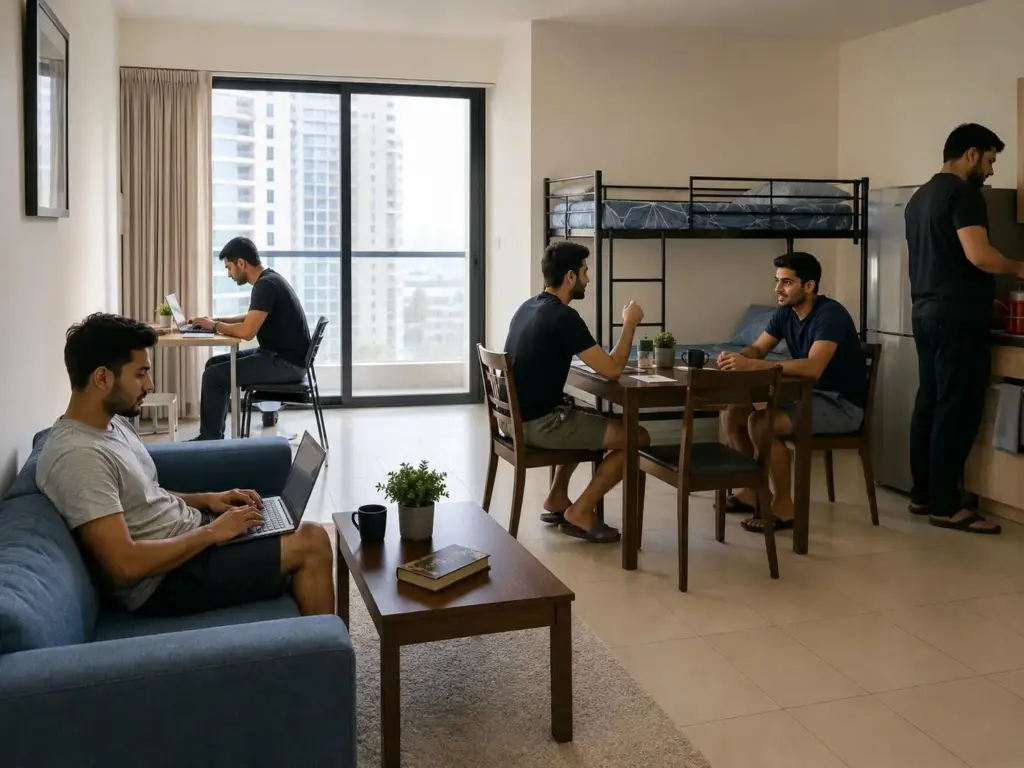
Ok real talk — i lived thru the “wild west” version of shared housing here. Partition walls made of who knows what, way too many ppl crammed into a 2 bed, no proper contract, nothing. This law exists bc that informal setup was creating real safety problems (fire risk from cheap partitions is a BIG one) and it was basically impossible for authorities to know who was actually living where.
Authorities have said the goals behind it are to protect owners and residents, stop overcrowding, fix building/land-use violations, promote fair rental practices, and generally bring some stability to the market. Honestly?? As someone who once lived next to a “room” that was literally a walk in closet with a mattress in it — i get it.
Who the Dubai Shared Housing Law Applies To
This is where ppl get confused so let me break it down simple. It applies to:
- Property owners who allocate their unit for shared housing
- Tenants actually living in a shared housing unit
- Licensed companies/establishments that manage or lease shared housing on an owners behalf
👥 Who the Dubai Shared Housing Law Applies To
| Party | Covered? | Notes |
|---|---|---|
| Property owners allocating a unit for shared housing | ✅ Mandatory | Must hold a valid Dubai Municipality permit |
| Tenants living in a shared housing unit | ✅ Mandatory | Cannot sublease a room, bed space, or partition to someone else |
| Licensed companies/establishments managing units on an owner’s behalf | ✅ Mandatory | Only these (or the owner) can legally lease shared accommodation |
| Collective labour accommodation | ❌ Not covered | Regulated under a separate system entirely |
| Units in private developments | ✅ Covered | Standard scope of the law |
| Units in free zones | ✅ Covered | Free zones are NOT exempt, despite common assumption |
And heres the part that really matters if ur currently in a shared flat: under the Dubai Shared Housing Law, regular tenants are NOT allowed to sublease a room, a bed space, or a partition to someone else. Like at all. Only the property owner, or a company thats specifically licensed for it, can legally rent out shared accommodation. So that classic move where you rent a 1BR and then rent out the spare room urself to cover rent?? Under this law thats no longer something a tenant can just do on their own.
Permits Under the Dubai Shared Housing Law
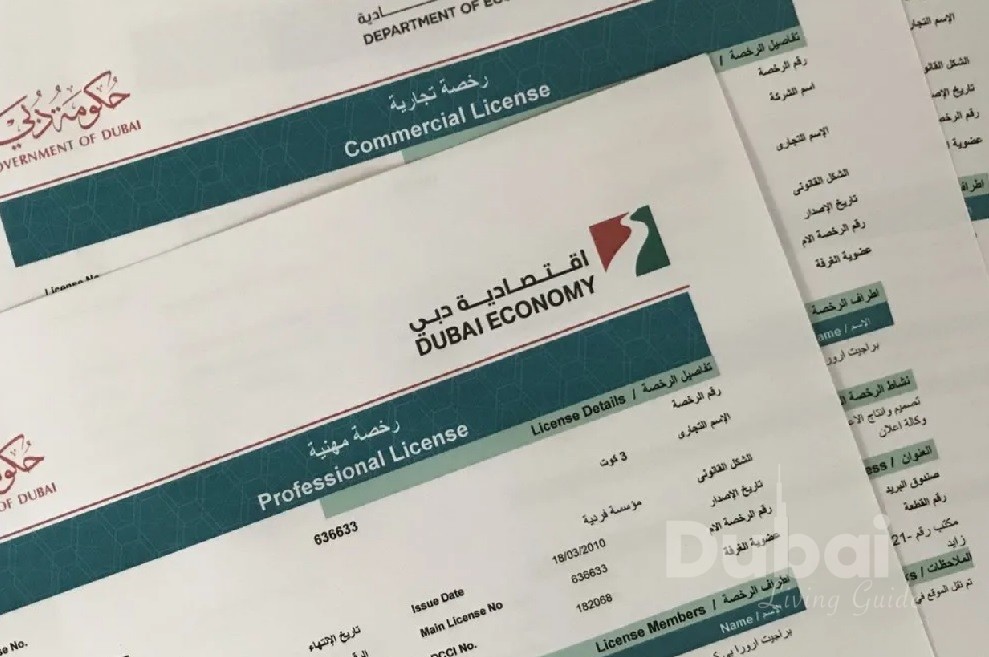
No permit = no shared housing, simple as that. The rule says no individual or entity can designate a property as shared housing without an approved permit from Dubai Municipality. This is honestly the bit id tell every landlord friend of mine to sort out asap — if you dont have the permit, everything else under the Dubai Shared Housing Law basically works against you.
Different sources describe slightly different space numbers (ive seen figures ranging from around 4 to 6 square metres per resident depending on the report), but the consistent theme across the guidance is that space has to come from actual living/sleeping areas — not the balcony, not the corridor, not the kitchen, not a bathroom, not a parking bay. If someone tries to count a storage room as “extra space,” thats not gonna fly.
📐 Dubai Shared Housing Law: Space & Compliance Requirements
| Requirement | Details | Mandatory? |
|---|---|---|
| Dubai Municipality permit | Required before any unit can be designated for shared housing | ✅ Mandatory |
| Minimum space per resident | Reported as roughly 4–6 sqm depending on source, from living/sleeping areas only | ✅ Mandatory |
| Fire-rated partitions | Cheap wood or non-fire-rated gypsum partitions not permitted | ✅ Mandatory |
| Written tenancy agreement | Contract recorded in the Shared Accommodation Register to be legally recognised | ✅ Mandatory |
| Excluded spaces for sleeping | Balcony, corridor, kitchen, bathroom, parking bay cannot count as living space | ❌ Not allowed |
Non fire rated partitions (like cheap wood or gypsum walls) are also a no. Honestly good — ive SEEN what those partitions look like up close and it is not it.
Fines Under the Dubai Shared Housing Law — This Is the Part Everyone’s Talking About
Ok this is probably why ur actually reading this article lol, bc the fines under the Dubai Shared Housing Law are no joke. The range starts at AED 500 and can go all the way up to AED 500,000 depending on how serious the breach is. And if the same violation happens again within one year? It can DOUBLE, up to a max of AED 1 million.
💰 Dubai Shared Housing Law: Fines & Penalties Breakdown
| Violation Scenario | Penalty |
|---|---|
| First-time / minor breach | AED 500 – AED 500,000 (severity-based) |
| Repeat violation within 1 year | Fine doubled, up to AED 1,000,000 max |
| Operating without a permit | Suspension of activity for up to 6 months |
| Serious / ongoing non-compliance | Permit cancellation, commercial licence revocation |
| Unresolved breach | DEWA/utilities disconnected until fixed, or eviction ordered |
Beyond just the money, authorities can also suspend the shared housing activity for up to 6 months, cancel the permit entirely, revoke commercial licenses, cut off DEWA/utilities until things are fixed, or order an eviction. Like this isnt a slap on the wrist situation, the Dubai Shared Housing Law has real teeth.

What This Means If Ur Already Renting a Bed Space or Sharing a Flat
I know a lot of ppl reading this are gonna be like “ok but what about ME, im just a tenant.” Fair question. Under the Dubai Shared Housing Law:
- Ask to SEE the permit before you move in. Especially for listings advertised as “bed space,” “partition room,” “executive sharing” or that sketchy “family only but multiple rooms available” wording — those are red flags this rule is specifically designed to catch.
- Get a real written agreement. It expects contracts to actually be documented, and there’s now a Shared Accommodation Register where tenancy contracts for shared housing are meant to be recorded to be legally recognised.
- Know that disputes go through the Dubai Rental Disputes Center, which has jurisdiction over issues arising under this framework.
- Understand that YOU (the tenant) legally cant sublease your bed or room to someone else under the Dubai Shared Housing Law, even if it feels like the “normal” thing everyone does.
✅ Pre-Move-In Checklist: Dubai Shared Housing Law Compliance
Run through this before you hand over a deposit for any bed space or shared room:
- ☐ Asked to see the Dubai Municipality permit for the unit
- ☐ Confirmed the person leasing to me is the owner or a licensed establishment (not just another tenant)
- ☐ Got a written tenancy agreement, not a cash-in-hand arrangement
- ☐ Checked that the DM licence number appears in the agreement
- ☐ Verified the space isn’t a converted balcony, kitchen, corridor, or storage room
- ☐ Checked the partition walls aren’t cheap wood/non-fire-rated gypsum
- ☐ Confirmed the listing wording isn’t a red flag (“bed space,” “partition room,” “family only but multiple rooms”)
- ☐ Know that disputes go through the Dubai Rental Disputes Center, not just the operator
Here’s a real example of why the Dubai Shared Housing Law matters, from my own circle — a friend of a friend (ill call her S bc she’d kill me if i used her real name lol) was renting a partitioned room in Deira for AED 900/month, no contract, cash in hand to a guy who wasnt even the landlord. When her building got inspected earlier this year as part of the lead up to the new rules, she had literally zero protection. No Ejari, no DEWA in her name, nothing to take anywhere if things went wrong. She got 48 hours notice and that was that. This is EXACTLY the situation the Dubai Shared Housing Law is trying to prevent going forward.
💎 Pro Tips: Navigating the Dubai Shared Housing Law
📋 Always ask to SEE the permit first
Before you move into any bed space or shared flat, ask the operator to show you the actual Dubai Municipality permit. Under the Dubai Shared Housing Law, no unit can legally operate as shared housing without one.
Red flags to watch for: listings saying “bed space,” “partition room,” “executive sharing” or “family only but multiple rooms available.”
🚫 Know that tenants can’t sublease — legally
That classic move where you rent a 1BR and rent out the spare room yourself to cover rent? Under the Dubai Shared Housing Law, that’s no longer something a regular tenant can do on their own — only the owner or a licensed establishment can rent out shared accommodation.
Smart move: if someone offers to sublet TO you, ask who actually holds the head lease.
📐 Balconies and kitchens don’t count as “living space”
Space requirements under the Dubai Shared Housing Law have to come from actual living/sleeping areas. A balcony, corridor, kitchen, bathroom or parking bay can’t be counted toward your square metreage.
Reported figures range from around 4 to 6 square metres per resident depending on the source.
🔥 Check what the partitions are actually made of
Non fire-rated partitions — think cheap wood or gypsum walls — are not allowed under the Dubai Shared Housing Law. If a partition looks flimsy, that’s a real fire-safety red flag, not just a cosmetic one.
Worth noting: fire risk from cheap partitions is one of the main reasons this law exists in the first place.
📝 Get everything in writing — including the DM licence number
The Dubai Shared Housing Law expects contracts to be properly documented, and there’s now a Shared Accommodation Register where tenancy contracts for shared housing are meant to be recorded to be legally recognised.
Pro tip: no written agreement usually means no protection if things go sideways.
⚖️ Know where to actually complain
Disputes tied to the Dubai Shared Housing Law go through the Dubai Rental Disputes Center, not just whoever you’re paying rent to. If something’s off with your unit, Dubai Municipality is your first stop.
This matters most if your “landlord” isn’t actually the property owner.
💰 Fines scale fast — and hard
Fines under the Dubai Shared Housing Law start at AED 500 and go up to AED 500,000 depending on severity, then DOUBLE for a repeat violation within a year, up to a max of AED 1 million.
Beyond fines: authorities can suspend the activity for up to 6 months, cancel permits, revoke commercial licences, cut DEWA, or order eviction.
⏰ Owners: the one-year compliance window is shorter than it feels
Existing operators generally get about one year to comply, which — based on the confirmed effective date of August 26, 2026 — runs to around August 2027. That’s not much time if you still need to sort permits, fix partitions, or restructure how the unit is leased.
Smart move: start the paperwork now, not closer to the deadline.
The One Year Compliance Window Under the Dubai Shared Housing Law
If your an owner or operator who was already running shared housing before the law took effect, you’re generally expected to get about one year to bring things into compliance — so based on the confirmed effective date of August 26, 2026, that runway looks like it runs to around August 2027. Thats not a huge amount of time tbh, especially if you need to sort out permits, fix partitions, or restructure how the unit is being leased. If your an owner and ur reading this and havent started the process yet… i would genuinely start now, not later.

My Honest Take on the Dubai Shared Housing Law
Look, i’m not gonna pretend the Dubai Shared Housing Law is perfect or that it solves the affordability problem — Dubai rent is still expensive af and thats a huge chunk of WHY shared housing exists in the first place. Studios are averaging somewhere around AED 52,000-59,000 a year depending which portal you check, and 1 beds can easily push past AED 90,000+ in a lot of areas. Sharing is still gonna be the move for a ton of ppl.
But ngl, i do think it’s a net good. Fewer sketchy partition setups, actual paperwork, an actual place to complain when things go wrong (RDC) instead of just hoping ur “landlord” (who might not even be the real landlord) does the right thing. The Dubai Shared Housing Law wont end shared living in Dubai, it’s just finally putting some real structure around it.
Quick Action Steps
If theres one thing id want you to take from this whole breakdown of the Dubai Shared Housing Law it’s this — dont just assume ur current setup is fine under the Dubai Shared Housing Law.
- Ask ur landlord/operator directly: “do you have the permit required under the Dubai Shared Housing Law?”
- Get everything in writing, including the DM licence number if there is one
- Dont agree to sublease FROM another tenant — under the Dubai Shared Housing Law that arrangement has basically no legal protection for you
- If somethings off, Dubai Municipality is your first stop, not just ur “landlord”
❓ Frequently Asked Questions About the Dubai Shared Housing Law
Bottom line on the Dubai Shared Housing Law — sharing an apartment in Dubai isnt going anywhere, and honestly it shouldnt — it’s how so many of us made this city work financially in those first few tough years. The Dubai Shared Housing Law just means doing it the right way from now on, and tbh, thats probably overdue.
P.S. This info is from Aug. 2026 but tbh things change fast in Dubai Shared Housing Law world so double check everything! And if ur reading this later… hope things have gotten even better lol